Bauman University
Bachelor’s degree in technical physics. Papers on the physics of magnetism in Russian and international journals.
I lead a team of AI engineers at the MWS AI Applied Solutions Center: 15+ computer vision systems in production. I teach at HSE University and MIPT and supervise the AI robotics course at Yandex Lyceum.
I take computer vision and generative models to production at MWS AI — and teach the next engineers to do it at HSE and MIPT.
Technical Lead, Applied Solutions Center
A team of seven AI engineers: CV system architecture, state-of-the-art model adoption, synthetic data, production-grade model optimisation. At MTS since 2019, from engineer to Principal Computer Vision Engineer — CV group, competence center, Computer Vision Center, now applied solutions.
Senior lecturer at the MTS base department, lecturer at the Center for Top AI Specialists, deputy head of the Robotics Lab
Academic supervisor of the master’s programme “Research and Entrepreneurship in Artificial Intelligence”, run jointly by HSE and MTS. At the Robotics Lab I am responsible for the team, the budget and industry partnerships. At the Faculty of Computer Science since 2023: 14 courses, five of them built from scratch, 400+ students, a 4.8/5 student rating, 21 supervised theses in two years, and school projects at Sirius.
Associate professor, Higher School of Software Engineering
Launched advanced computer vision and MLOps courses for undergraduates. From autumn 2026 also at the FPMI Center for Practice and Internships.
Academic supervisor of the AI robotics course
Designed and ran an intelligent robotics course for Yandex Lyceum within the Physical AI programme. The pilot ran at 11 sites across 8 regions of Russia.
Computer vision systems running in production at MWS AI — the full cycle from research to scaling. Total project budget above 200M RUB.
98.5% recognition accuracy, 15× faster than manual digitisation.
Manual review reduced by 80%: video, chat and audio analysed around the clock.
Production time per poster cut from two hours to five minutes.
mAP@0.5 = 0.89; conveyor sorting accuracy improved by 35%.
Room classification with 92% accuracy.
Reed–Solomon-coded steganography: the watermark survives transcoding and removal attempts.
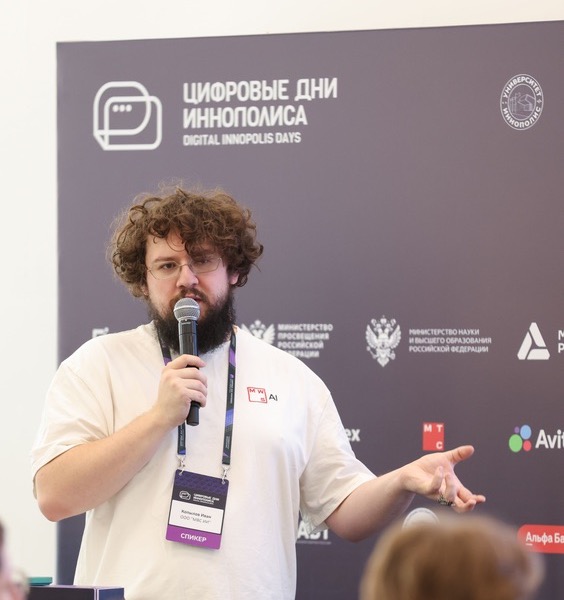
Computer vision engineer, at MTS since 2019: the CV group of the Machine Learning department at MTS AI, the competence center, the Computer Vision Center — from engineer to Principal Computer Vision Engineer. Along the way I shipped more than 15 systems to production — from OCR for a national library to video moderation and industrial defect detection — with synthetic datasets and augmentation pipelines as a specialty. Since July 2026 I lead the Applied Solutions Center at MWS AI.
I teach in parallel. At HSE I run MLOps, computer vision, advanced video analytics and GPU computing, teach at the Center for Top AI Specialists, supervise graduation theses — 21 defended in two years — and serve as deputy head of the Robotics Lab: perception systems, semantic navigation, SLAM, plus the team, budget and industry partnerships. At MIPT I am an associate professor at the Higher School of Software Engineering, and for Yandex Lyceum I designed an AI robotics course. In 2025 and 2026 the students of the Faculty of Computer Science voted me Best Teacher, and in 2025 my colleagues at MWS named me Teacher of the Year.
Education: Bauman Moscow State Technical University, technical physics (2013–2017); master’s in management, Moscow International Academy (2022–2024); Stanford’s Machine Learning course on Coursera (2019). Five physics publications, including Journal of Physics: Conference Series and Journal of Surface Investigation: X-ray, Synchrotron and Neutron Techniques. English at C1. I organise meetups and conferences and mentor young engineers.
Bachelor’s degree in technical physics. Papers on the physics of magnetism in Russian and international journals.
Joined MTS as a computer vision engineer: first systems for one of the country’s largest technology companies.
Lead developer of the CV group, Machine Learning department: OCR for a national library, video moderation, cinema poster automation.
Lead developer of the computer vision competence center at MTS AI: industrial defect detection, image analytics.
From March — lecturer at the Faculty of Computer Science: Computer Vision, C++ and Python, in English.
Big Data and Information Retrieval School, HSE. Courses “Operation of Machine Learning Models” and “Image Analysis and Computer Vision”. Master’s in management. MTS Day at HSE.
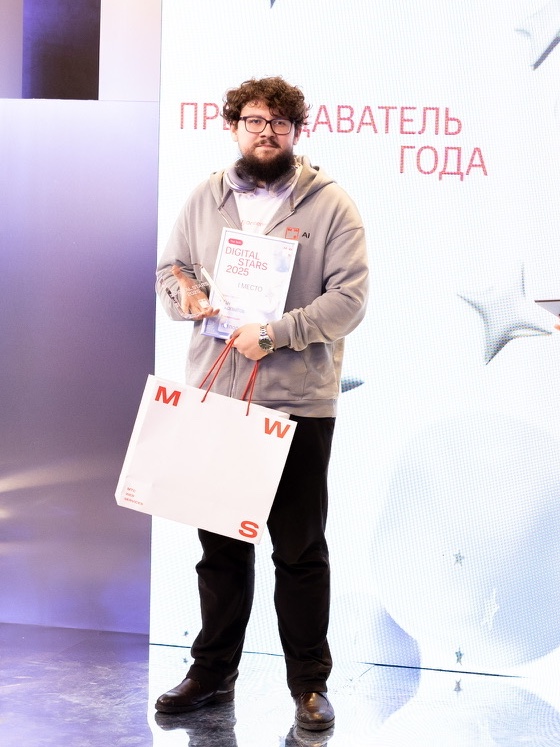
HSE Best Teacher by student vote, Teacher of the Year at the MWS Digital Stars awards and Best Deal of Q3. Associate professor at MIPT; an AI robotics course for Yandex Lyceum — a pilot at 11 sites in 8 regions. A voice-controlled robot built at Sirius.
Computer Vision Center, then the Applied Solutions Center at MWS AI. At HSE — deputy head of the Robotics Lab, academic supervisor of the HSE × MTS master’s programme and lecturer at the Center for Top AI Specialists. HSE Best Teacher for the second year running. 17 thesis students and a VLA-model project at “Big Challenges” in Sirius.
Elected two years running by the students of the Faculty of Computer Science. In 2025 the course “Image Analysis and Computer Vision” was named the best in the master’s programme by one of the criteria. Student rating: 4.8 out of 5.
First place in the MWS corporate awards. Organised MTS’s participation in the HSE Summer School on Data Analysis and spoke there as an expert; launched the new “Advanced Video Analytics” course.
A corporate award for the best deal of the quarter: computer vision projects deliver measurable business results — total implementation budget above 200M RUB.
“Research and Entrepreneurship in Artificial Intelligence”: LLMs, generative models, computer vision and technology entrepreneurship. 40 places, 30 of them fully funded by MTS.
2025: together with Andrey Bondarev, supervised a team of school students (HSE × Yandex) who built a robot with semantic navigation and a voice interface — response time under three seconds. 2026: led the project “A VLA agent for complex scenarios and object manipulation” — the students taught a VLA model to control a robot manipulator and stack a pyramid of cubes in the programme’s first international season: 400+ participants, 76 projects.
Co-led discussions on robotics education and key industry trends with Vadim Morgachev. The first robotic-arm programming hackathon, with Yandex Education.
Bachelor’s and master’s courses at the HSE Faculty of Computer Science, the Center for Top AI Specialists, MIPT and Yandex Lyceum — from a first Python script to models running in production. Five of the courses were built from scratch.
More than twenty media mentions: I comment on the AI market, access to models and physical AI for Forbes, TASS, RIA Novosti, RBC, Rossiyskaya Gazeta and Baza.
After an IPO, investors look not only at audience growth but also at costs.
Before an IPO it pays to show maximum reach in paid subscriptions.
We are seeing a new active wave of checks, but it affects users from all countries.
Keeping the only copy of important information inside a chat is a risky approach by design.
Robotics needs mechatronics, physics and electronics; AI needs mathematics and algorithms.
Most likely we will see an additive model, where robots amplify human capabilities.
Retrieval from predefined sources also significantly reduces the risk of hallucinations; in 2025 it is already present in almost every enterprise product.
Author of the RuCode 2025 AI-track cases together with Mikhail Stepnov.
Every year “Big Challenges” brings more and more capable school students.
Discussions on robotics education and key industry trends.
I was pleasantly surprised by the high level of the students’ preparation.
AI moderation keeps the balance between accuracy of assessment and speed of reaction.
Consulting on CV and AI projects, speaking engagements, educational programmes, press commentary.
ivan@kopylov.ai